

By Johannes Westphal, CEO of That Works Media (AI video production, Berlin) · Updated 5 October 2026
In short: Since 2 August 2026, Article 50(4) of the EU AI Act requires anyone who publishes AI-generated or AI-manipulated images, video or audio that look real to disclose it, at the latest at first exposure. There is no exemption for advertising, and it applies to non-EU brands whose ads reach people in the EU. A typical disclosure label reads “Ad | Made with AI”.
Jump to the free kit (decision tree, checklist, copy templates, 28 label graphics)
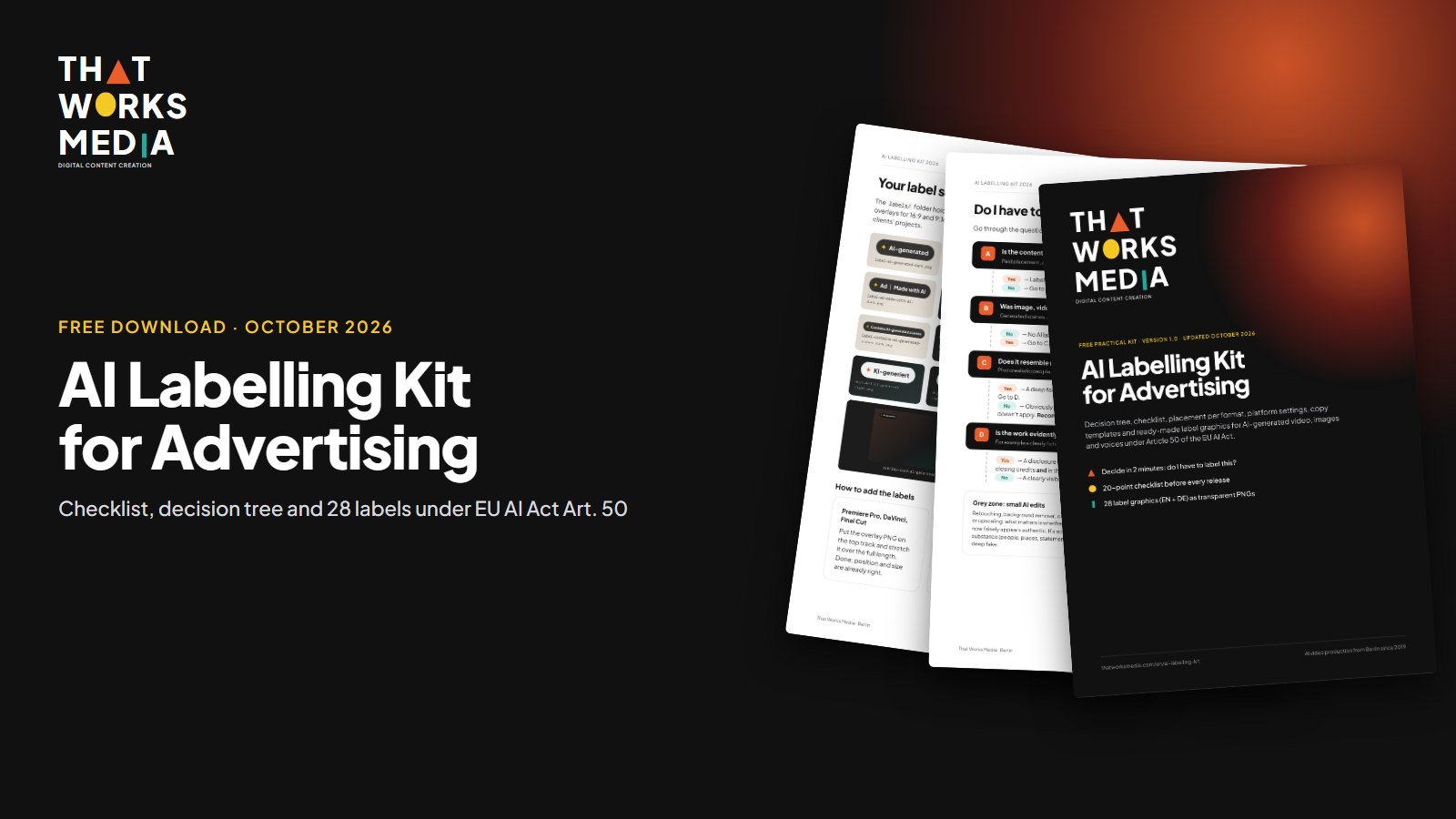
Do I have to label it? The 4-question decision tree
- Is it advertising? Then label it as an ad (“Ad”, “Sponsored”), as consumer law already requires.
- Was image, video or audio generated or changed with AI? If not, no AI label is needed under Art. 50(4).
- Does it look real (real people, products, places or events)? Then it is a deep fake under the AI Act: label it clearly as AI-generated, at the latest at first exposure.
- Is the work evidently artistic, satirical or fictional? Then a disclosure that doesn’t hamper the work is enough. Otherwise: clearly visible on screen, or audible in the sound.
For real examples of AI in advertising, see the best AI-generated commercials of 2026 and our guide on how brands use AI for ads.
Examples: what needs an AI label?
Our assessment of 9 typical cases from ad production. What matters is whether the content could falsely appear authentic.
| Case | AI label required? | Suitable label |
|---|---|---|
| Photorealistic AI avatar speaks in the ad | Yes | AI-generated person |
| Synthetic or cloned voice that sounds real | Yes, even audio-only | “The voice in this ad is AI-generated.” |
| AI-generated product shot in a realistic setting | Yes | AI-generated |
| Background or scene replaced by AI, looks real | Yes | Contains AI-generated scenes |
| Face swap or deep fake of a real person | Yes, plus the person’s consent | AI-generated person |
| Evidently fictional short film with AI imagery | Yes, but discreetly (credits and description) | A film with AI-generated imagery |
| Clearly drawn or abstract AI animation | Usually not; voluntary label recommended | Made with AI |
| Upscaling, colour correction or denoising without changing content | Usually not | none needed |
| Ad copy written with AI | Not under Art. 50 (only public-interest text without editorial responsibility) | Still label the ad as an ad |
AI disclosure label examples you can copy
- On screen: “AI-generated”, “Made with AI”, “Ad | Made with AI”, “Contains AI-generated scenes”, “AI-generated person”
- Spoken (radio, podcast, voice ad): “This ad was created with artificial intelligence.”
- Caption or ad copy: “Ad. This video was made with AI. People and scenes shown are not real.”
- German: “KI-generiert”, “Mit KI erstellt”, “Anzeige | Mit KI erstellt”
Placement: the law asks for “clear and distinguishable, at the latest at first exposure”, but sets no size. Our production recommendation: in video, from the first frame in a top corner, text height at least 3.5% of the frame height (about 38 px at 1080p); on Reels and TikTok throughout, outside the bottom third.
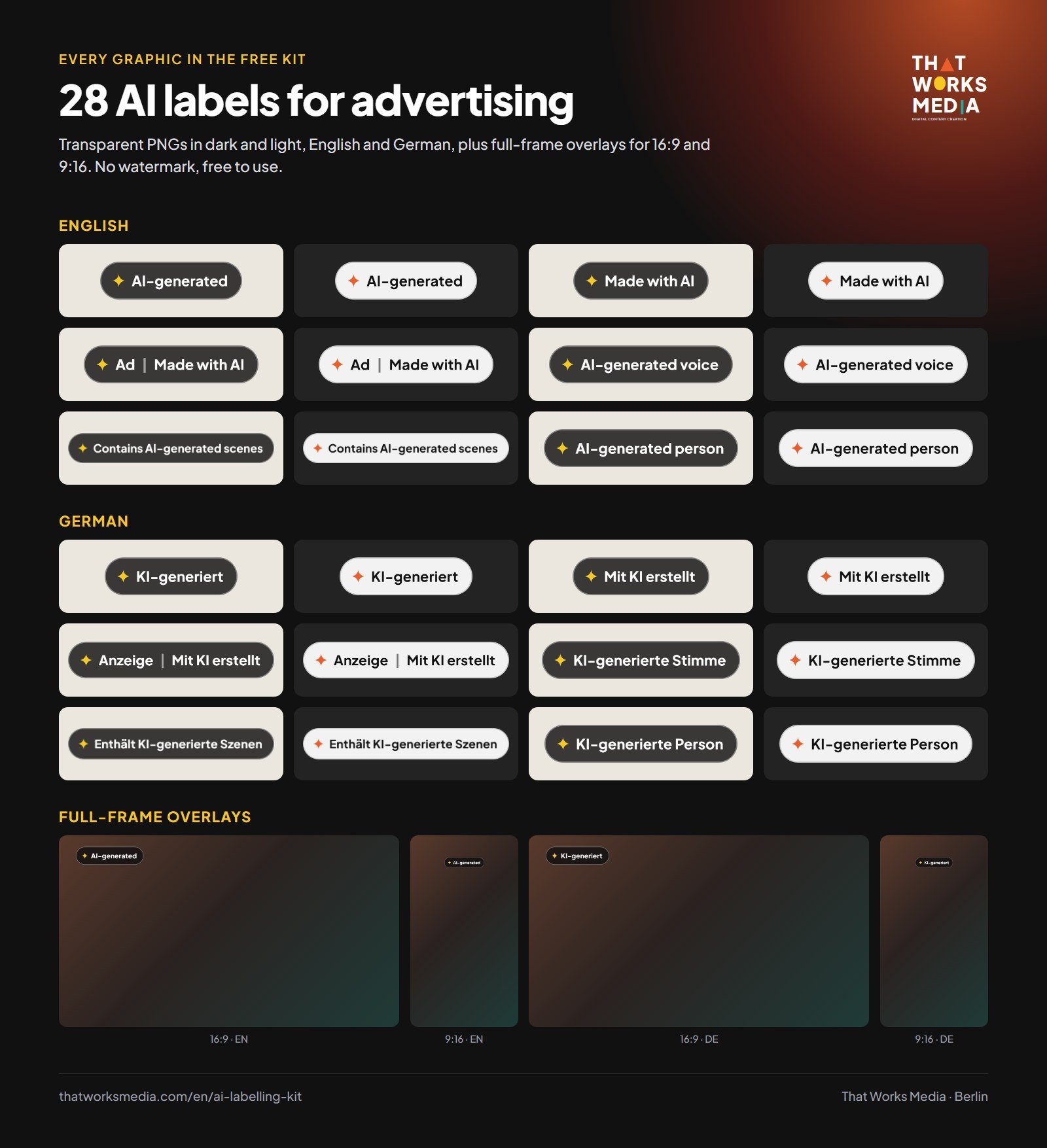
Download the free AI Labelling Kit
- Decision tree and 20-point checklist before every release
- Placement per format: TV, Reels, TikTok, Shorts, feed, DOOH, radio, website
- Platform settings for Meta, YouTube, TikTok, LinkedIn and Google Ads
- Copy templates for overlays, voice, captions, credits and an agency contract clause (EN + DE)
- 28 label graphics as transparent PNGs plus full-frame overlays for 16:9 and 9:16, no watermark, free to use
Enter your email address and confirm it. Then you can download the kit right away (ZIP, 2.7 MB, guide as a PDF in English and German).
In exchange for the free kit you’ll receive our newsletter: kit updates when rules or platform settings change, and practical tips on AI advertising, at most twice a month. Unsubscribe any time with one click. See our privacy policy.
FAQ: AI labelling in advertising
When did the AI labelling obligation start?
The transparency obligations of Article 50 of the EU AI Act apply since 2 August 2026. For machine-readable marking by AI providers, systems placed on the market before that date have a transition period until 2 December 2026.
Does the EU AI Act apply to US and other non-EU companies?
Yes, if the AI-generated content is used in the EU, for example in ads shown to people in the EU. Where the advertiser or agency is based doesn’t matter.
Do I have to label AI images and videos on social media?
Yes, if they look real. Article 50 applies to every channel. Meta, YouTube and TikTok also have their own AI labels at upload. They don’t replace the disclosure in your content; they come on top.
Does an AI voice need a disclosure?
Yes, if it sounds real. For audio-only formats such as radio, podcasts or voice ads, the European Commission’s code of practice provides for a spoken disclaimer, for example “The voice in this ad is AI-generated.”
Who has to label: the brand or the agency?
The deployer, meaning whoever publishes the AI content. In advertising that is usually the brand. Agree in the agency contract who supplies the labels; the kit includes a clause for that.
How big does an AI disclosure label have to be?
The law sets no size, only “clear and distinguishable” and accessible. As a practical value we recommend at least 3.5% of the frame height, shown from the first frame.
What are the fines for missing AI labels?
Up to €15 million or 3% of worldwide annual turnover, whichever is higher (Art. 99(4); for SMEs, whichever is lower), plus consumer-law claims and the risk of platforms removing content.
Is the EU icon from the code of practice enough?
The Commission’s code of practice of 10 June 2026 asks deployers to use the publicly available EU icon or equivalent labels. The text labels in the kit are designed as such equivalent labels. We’ll add the EU icon to the kit once it is freely available.
Can I use the labels in client work?
Yes. The label graphics carry no watermark or logo and may be used freely in your own and your clients’ projects, including commercially.
Planning an AI ad? Free labelling check
Send us your AI spot or campaign asset. In a 20-minute video call we’ll tell you what needs a label, where it goes and which platform settings you need. That Works Media has produced video in Berlin since 2019, today mostly AI commercials, explainer videos and e-learning.
Request a labelling check (subject: “Labelling check”)
Sources
- Regulation (EU) 2024/1689 (EU AI Act), in particular Art. 3(60), Art. 50 and Art. 99
- European Commission: Code of Practice on marking and labelling AI-generated content, published 10 June 2026 (summary by Jones Day)
Kit version 1.0, updated 5 October 2026. This page and the kit are general information, not legal advice, and do not replace a review of your case by a lawyer. Placement sizes and durations are production recommendations, not legal requirements.