
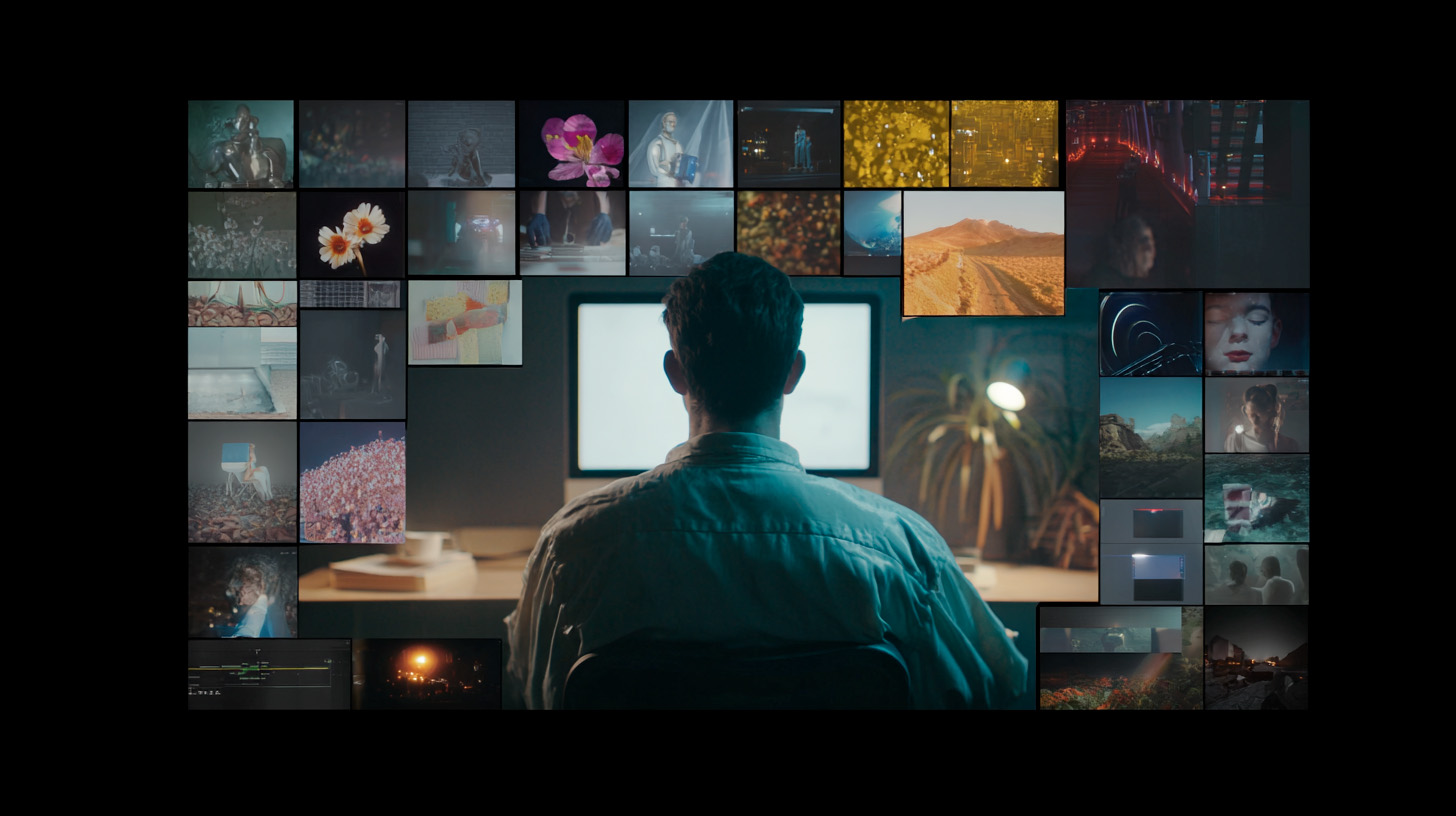
Artificial intelligence is transforming the advertising world right now, radically. What used to require weeks of shooting, large crews and hefty budgets can today be delivered in a matter of days using AI tools such as Google Veo 3, Runway, Kling or ElevenLabs.
This technology does not only enable efficiency, it also opens up entirely new creative possibilities. The lines between „real” and generated advertising are blurring rapidly. Major brands, start-ups and creative studios around the world are already testing how far you can push AI. And here at ThatWorksMedia in Berlin, we also produce AI-driven spots, fast, effective and visually top-tier.
🧠 The evolution of AI in the advertising industry
- Phase 1: Data-driven targeting. AI initially helped optimise audiences, headlines and ad placements.
- Phase 2: Generative content. Tools like ChatGPT, DALL-E and Midjourney made it possible to create text, images and short animations.
- Phase 3: Full commercials from the machine. Thanks to video AI models like Google Veo 3, Runway Gen-4.5 or Kling 3.0, entire clips including storyboard, imagery and voiceover can now be AI-generated.
- Phase 4: Strategic maturity. In 2026, AI advertising has come of age. Brands use AI to solve concrete business problems instead of producing pure effect demos.
Using AI in your own ads?
Since August 2026, realistic AI images, video and voices in ads reaching the EU must be disclosed. Our free kit has a decision tree, a checklist and 28 ready-made labels.
🎬 The 8 most exciting AI commercials of 2026
1. Deutsche Telekom, the AI Einstein spot with ElevenLabs
- What: A fully AI-generated commercial featuring a digitally revived version of Albert Einstein.
- Why it matters: Deutsche Telekom, in collaboration with agency Jung von Matt, presents its first fully AI-generated advertising production. The film opens in the Berlin-Wilmersdorf of 1924 and cuts to the present at Potsdamer Platz. There, Telekom board member Jonathan Abrahamson meets ElevenLabs founder Mati Staniszewski. The spot marks a DAX-listed corporation’s entry into full AI ad production.
2. Popeyes, „Wrap Battle” diss track against McDonald’s
- What: A satirical, fully AI-generated rap video spot as a response to McDonald’s bringing back the Snack Wrap.
- Why it matters: Only three days of production time, distributed virally on TikTok, Instagram and X. AI filmmaker PJ Accetturo produced the spot entirely with Google Veo 3, music was created with Suno. This is reactive brand communication in the AI era, impossible to pull off with classic production.
3. Mango, Sunset Dream fashion campaign (Mango Teen)
- What: The first fully AI-generated fashion campaign from a major European fashion group.
- Why it matters: Mango developed a complete visual campaign for the limited Sunset Dream collection with generative AI. Real photographs of each garment served as training data for an AI model, which then produced images of synthetic models in editorial quality. The campaign was rolled out across 95 markets and forms part of Mango’s Strategic Plan 2024 to 2026.

4. Under Armour, „Forever Is Made Now” with Anthony Joshua
- What: A monochrome, fast-cut commercial for boxer Anthony Joshua, produced entirely without direct athlete access.
- Why it matters: Under Armour tasked production company Tool and director Wes Walker with a classically impossible brief: build a film from nothing but existing assets, a 3D model of Anthony Joshua and no access to the athlete. The result combines AI video, AI photo, 3D CGI, VFX, 35mm film and AI voiceover, delivered in three weeks. The spot is also an important case study due to ethical debates around crediting.
5. Atera, end-to-end generated B2B spot
- What: A fully AI-generated commercial for IT management software Atera.
- Why it matters: Every single frame of the campaign was created with AI. Runway delivered the video, ElevenLabs the voices. The concept: a fictional world in which IT professionals can live without stress and chaos. As a B2B example, the spot demonstrates that AI advertising works far beyond consumer brands.
6. Liquid Death, ongoing AI video experiments
- What: The beverage brand uses Google Veo 3 systematically for viral short clips.
- Why it matters: Liquid Death, already known for unconventional marketing, regularly produces short AI-generated video assets for social media. The focus is on absurdity and surprise, which perfectly matches the brand’s tone while pushing the boundaries of what Google Veo 3 can deliver. This is continuous AI use as a content strategy, not a one-off stunt.
7. Nike, Midjourney-based image campaigns
- What: Nike uses Midjourney for ideation, storyboards and final image assets in selected campaigns.
- Why it matters: Instead of booking classic photo shoots, entire image worlds and campaign visuals are generated directly from the model. This dramatically reduces pre-production times. Nike shows how a major brand uses AI not as a replacement, but as an accelerator of classic ad production.
8. Heinz, DALL-E campaign on brand iconography
- What: Heinz used DALL-E 2 (and later successor models) to demonstrate the brand’s visual self-evidence.
- How it came about: The marketing idea was simple and powerful. When people ask AI image generators for „ketchup”, the result almost always looks like a Heinz bottle, even without mentioning the brand name. Heinz built a campaign around that insight, staging its own iconic visual language as shared cultural knowledge.
- Why it matters: Heinz uses AI image generators as proof of brand strength, not just as a production tool. This meta-strategic use shows a truly distinct creative application of generative AI in marketing.
What does the EU AI Act mean for AI commercials?
An important context for every brand planning AI advertising in 2026: since 2 August 2026, the transparency rules of the EU AI Act (Regulation (EU) 2024/1689) apply in full. AI-generated advertising videos that depict real people, places or events in a photorealistic way (deepfakes) must be visibly labelled as AI content. (Source: European Commission, Digital Strategy, as of 11 May 2026)
The Telekom Einstein spot shows how a corporation can address this proactively: the AI character is not hidden, but turned into the very concept of the ad. Anyone planning today should build labelling obligations into concept and design from the start. You can find more details in our blog posts on labelling requirements for AI commercials and our EU AI Act checklist for marketing teams.
Overview of the 2026 AI ad campaigns
Here are the eight examples at a glance.
#
Campaign, tool and highlight
1
Deutsche Telekom, Einstein
Tools: ElevenLabs, AI video
Highlight: First full AI production by a DAX-listed corporation.
2
Popeyes, Wrap Battle
Tools: Google Veo 3, Suno
Highlight: Three-day reactive campaign.
3
Mango, Sunset Dream
Tools: Trained GenAI image models
Highlight: First full production by a fashion brand.
4
Under Armour, Anthony Joshua
Tools: AI video, 3D CGI, AI voice
Highlight: Hybrid production without athlete access.
5
Atera, IT utopia
Tools: Runway, Sora, ElevenLabs
Highlight: Complete B2B production.
6
Liquid Death
Tools: Google Veo 3
Highlight: Continuous social content strategy.
7
Nike, image campaigns
Tools: Midjourney
Highlight: Acceleration of classic campaigns.
8
Heinz, brand iconography
Tools: DALL-E 2
Highlight: Meta use of AI as proof of brand power.
📊 Benefits of AI advertising
Radically lower costs
50 to 70 percent lower production costs compared to classic shoots.
Creativity at scale
More variants, more tests, more adaptation, in real time.
Time is no longer a limit
From idea to final clip in days instead of weeks.
Emotion still decides
Despite the tech, the story still has to move people.
Compliance is the new standard
EU AI Act since 2 August 2026: AI commercials featuring real people must be visibly labelled.
🚀 The 2026 tool stack for AI advertising
Google Veo 3
Cinematic quality with native audio. Notable case: Popeyes Wrap Battle.
Runway Gen-4.5
Creative control and editing workflows. Notable case: Atera spot.
Kling 3.0
4K output for cost-sensitive volume production.
ElevenLabs
Voice cloning and synthetic voices. Notable case: Telekom Einstein spot.
Midjourney
Storyboards and image campaigns. Notable case: Nike visuals.
Suno
AI-generated music, jingles and custom tracks.
Good to know: OpenAI discontinued Sora on 24 March 2026. Anyone planning AI advertising in 2026 should verify their tool stack against current availability.
🚀 Additional use cases for AI films
AI campaigns with live A/B tests
Test voice, look and message in parallel and optimise in real time.
Synthetic brand ambassadors
Digital avatars with swappable faces and languages for global campaigns.
Hyper-localised commercials
One spot, produced in Berlin, adapted for Tokyo, Madrid or Cape Town.
Reactive three-day campaigns
Campaigns like Popeyes’ Wrap Battle, responding to competitors within the same news cycle.
FAQ
Frequently asked questions about AI-generated commercials
What is the best-known AI-generated commercial of 2026?
Among the best-known AI-generated commercials of 2026 are the Deutsche Telekom Einstein spot with ElevenLabs (produced by Jung von Matt, released in June 2026), the Popeyes Wrap Battle diss track (Google Veo 3, three-day production time) and the Mango Sunset Dream fashion campaign. All three used AI to solve a specific production challenge.
Which AI tools are used for commercials in 2026?
The professional market in 2026 is dominated by Google Veo 3 (cinematic quality), Runway (editing workflows), Kling 3.0 (4K volume production), ElevenLabs (voice cloning), Midjourney (image worlds) and Suno (music). OpenAI Sora was discontinued on 24 March 2026 and is no longer available.
How long does it take to produce an AI commercial?
Production time depends on the ambition. Reactive social campaigns like the Popeyes Wrap Battle were produced in three days. The Under Armour spot took three weeks including hybrid production. Full campaign spots typically take between two and six weeks, compared to two to four months with purely classic production.
Are AI commercials cheaper than classically produced spots?
Yes, significantly. AI commercials save an average of 50 to 70 percent of the cost compared to classic productions, because AI automates manual tasks such as editing, retouching and effects. The Popeyes Wrap Battle was produced for a fraction of a traditional production budget. The exact saving depends on ambition and tool stack.
Do I have to label an AI commercial as such?
Yes, since 2 August 2026 the transparency rules of the EU AI Act (Regulation (EU) 2024/1689) apply in full. AI-generated advertising videos that depict real people, places or events in a photorealistic way (deepfakes) must be visibly labelled as AI content. Obviously stylised animations in a comic or cartoon style are exempt.
Why was Sora discontinued?
OpenAI shut down Sora on 24 March 2026. Downloads had plunged 75 percent from their November 2025 peak, and the planned billion-dollar Disney deal fell through. Lifetime app revenue amounted to around 2.1 million dollars. OpenAI refocused on productivity in its B2B business. Google Veo 3 and Kling 3.0 took over market leadership in AI video.
🤝 Want the same for your brand?
At ThatWorksMedia, we combine AI technology with storytelling to create smart, striking commercials. Whether for brand launches, product videos or viral campaigns, we deliver AI content that works. And we always factor the new EU AI Act compliance requirements in from the start.
📍 Produced in Berlin. Made for the world.
🎬 Get in touch about your project, we’ll show you what’s possible.
Note: This article is for general information only and is not legal advice. For advice on your specific situation, please consult a lawyer.