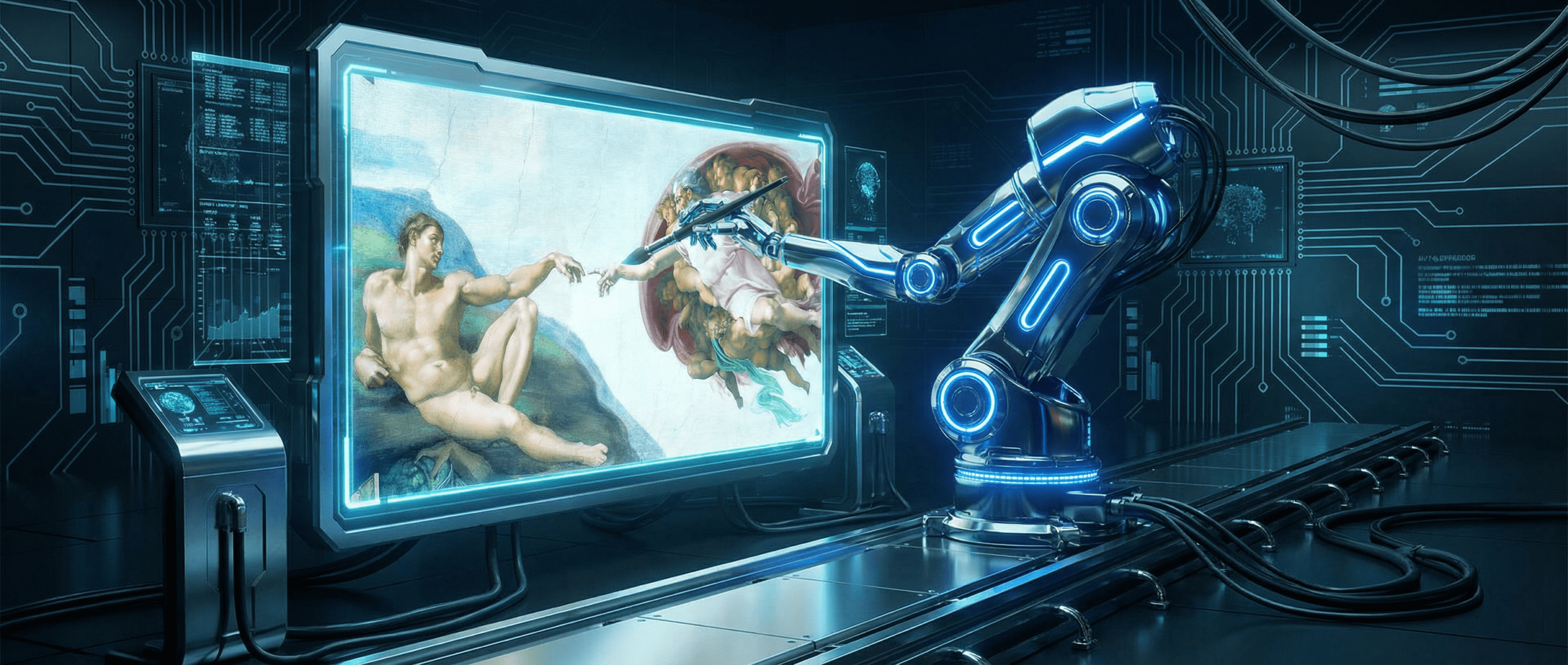
Generative artificial intelligence has long arrived in everyday life. Image generators, text AI, and music models create content in seconds. This raises a central question that is being asked more and more frequently: Can AI really create art?
For businesses, agencies, and creative professionals in Berlin, across Germany, and throughout the DACH region, this question is particularly important. Because AI is changing not just processes, but also our understanding of creativity, authorship, and cultural value. (Source: AI-Facts, KI-Union)
While some AI images are being exhibited in galleries, others use AI as a tool for campaigns, design, or storytelling. But where does technology end — and where does art begin? (Source: AI-Facts)
What Does “Art” Mean in the Context of AI?
To answer this question, we first need to clarify what art actually is.
Traditionally, art is considered an expression of human experience. It arises from emotions, lived experiences, intentions, and decisions. A human consciously selects colors, shapes, or words. This is what creates meaning. (Source: IKI-Glossar)
With generative AI, things are different. AI systems possess no consciousness. They feel nothing. They have no intention. Instead, they analyze large volumes of data and identify patterns within it. On this basis, they generate new content. (Source: IKI-Glossar)
This raises the question: Is a beautiful result enough to call something art? Or does it necessarily require a human origin? (Source: Arts Material)
How Generative AI “Creates” Art
Generative AI works very efficiently on a technical level, but conceptually it is straightforward.
First, the model is trained on enormous amounts of data. For image AI, this means millions of images with descriptions. For text AI, it means books, articles, and websites. The AI learns which patterns belong together. (Source: SocietyByte)
When a prompt is later entered, the model calculates which result is statistically the best fit. It doesn’t paint a picture from its own imagination. It recombines what it has learned. (Source: SocietyByte)
The result can appear creative. It can surprise. Nevertheless, the AI makes no conscious decisions. It follows probabilities. (Source: SocietyByte)
Examples of AI-Generated Works
A particularly well-known example is the image “Théâtre D’opéra Spatial.” It was created in 2022 using the AI tool Midjourney and won an art competition in the United States. This sparked worldwide debate. (Source: Dataconomy)

Many people found the work impressive. Others criticized the idea that an algorithm should be able to win an art prize. Importantly: The prize was not awarded to the AI, but to the person who used it. (Source: Dataconomy)
In 2024, the debate resurfaced. At the Brisbane Portrait Prize, AI works were explicitly permitted. This triggered discussions about fairness, creativity, and authorship. (Source: The Guardian)
These examples show:
- AI art is being taken seriously
- But it challenges existing rules
(Source: The Guardian)
Can AI Truly Be Creative?
Creativity means more than a beautiful result. It involves intention, context, and meaning.
AI has no goals of its own. It doesn’t know what art is. It doesn’t know why something moves people. That’s why many art theorists say: AI cannot possess creativity in the human sense. (Source: Arts Material)
At the same time, many people experience emotional reactions to AI works. They feel addressed. They interpret meaning into the work. (Source: Arts Material)
This leads to a compelling question: Does art only come into being in the mind of the viewer? If so, then AI can at least be a trigger of art. (Source: Arts Material)
Legal Perspectives: Copyright and AI Art
Beyond the cultural question, there is a legal one. It is particularly relevant for businesses.
In the United States, a federal court ruled that works created entirely by AI do not qualify for copyright protection. The reason: There is no human author. (Source: Reuters)
The U.S. Copyright Office also confirms:
- Purely AI-generated content is not protectable
- Human contributions can establish protection
(Source: The Verge)
For agencies, studios, and businesses in Berlin, this means: AI art is usable, but legally sensitive. Particular caution is needed in advertising, brand identity, and campaigns. (Source: Reuters)

How Artists and Creatives Are Responding to AI
The reactions to AI vary widely.
Many artists use AI as a tool. They generate ideas, test variations, and accelerate processes. Similar to how photography or digital design were adopted in earlier eras. (Source: TIME)
Others express concern. They fear a devaluation of human work. Or a flood of interchangeable content. (Source: TIME)
In Berlin, both are visible:
- Experiments with AI music, AI visuals, and AI performances
- Critical engagement with authorship and power
(Source: TIME)
Democratization or Cultural Flattening?
A clear advantage of AI is the democratization of creativity. People without formal training can create images, music, or text. This lowers barriers to entry. New voices become visible. (Source: Arts Material)
At the same time, there is a risk. Many AI models were trained on similar data. As a result, many outputs resemble each other. (Source: Arts Material) In the long term, this could lead to stylistic uniformity. Diversity and experimentation could suffer. (Source: Arts Material)
Interested in more on the relationship between art and artificial intelligence? Check out what the team at Arte has put together:
FAQ – Generative AI and Art
1. Can generative AI create real art? AI can produce impressive works. Whether they qualify as art depends on definition and perspective. (Source: Arts Material)
2. Who owns the copyright to AI art? In many countries, not the AI. Only human contributions can be protected. (Source: Reuters)
3. Is AI art original? AI combines existing patterns. It does not create from its own experiences or intentions. (Source: SocietyByte)
4. Can AI support artists? Yes. Many use AI as an inspiration and production tool. (Source: TIME)
5. Is AI art commercially usable? Yes, but legal questions regarding licenses and data should be examined. (Source: Forbes)
Conclusion: AI, Art, and the Future of Creativity
Generative AI is transforming the art world in lasting ways. It produces images, music, and text that can move people. Nevertheless, it remains a tool — not an artist in the human sense. (Source: AI-Facts)
For businesses and creatives in Berlin, across Germany, and throughout the DACH region, the opportunity lies in using AI deliberately. Not as a replacement, but as an extension of human creativity. (Source: KI-Union)
ThatWorksMedia helps businesses integrate generative AI meaningfully, legally, and creatively into content strategies, campaigns, and innovation workflows — with a focus on quality, responsibility, and real added value.