
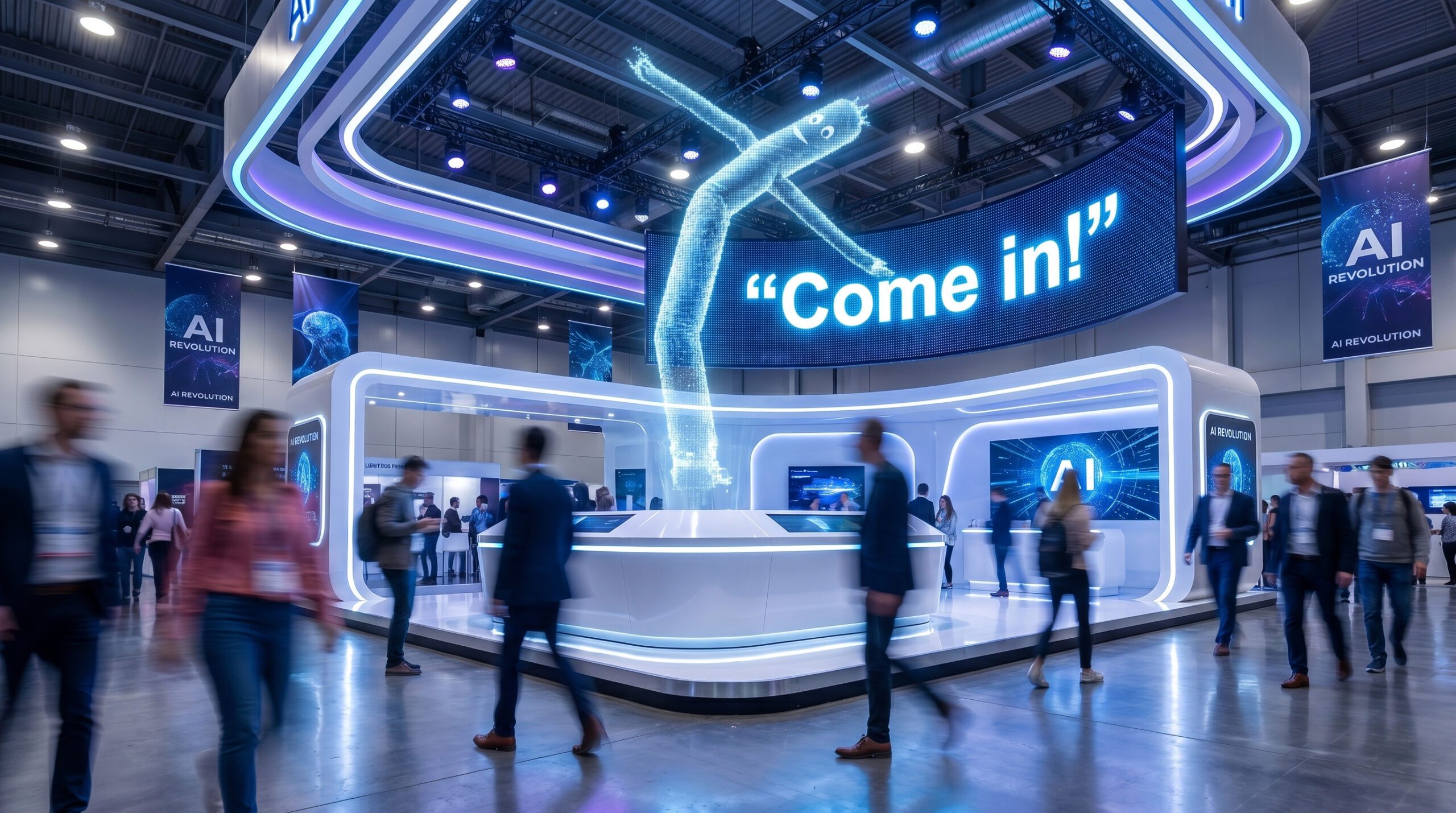
A trade show booth has three seconds. Three seconds to get a decision-maker walking by to stop and pay attention. In that brief window, it is decided whether a visitor turns into a lead, or whether your appearance drowns in the noisy background of a trade fair. This is precisely where AI videos offer a major opportunity. They grab attention, explain complex offerings in seconds, and deliver a speed that classic production chains can no longer match.
At ThatWorksMedia, we work every day on video formats that perform at trade shows. In this article, we show you how to use AI videos strategically for your booth appearance, which formats have proven effective, and where the technology reaches its limits.
Why Trade Shows Are the Perfect Playing Field for AI Videos
Trade fairs are among the most effective B2B marketing measures. An AUMA trend study shows that trade fairs are essential in the marketing mix for 83 percent of German exhibiting companies. (Source: SAXOPRINT) At the same time, B2B companies plan to allocate around 45 percent of their marketing budget to such events in the future. (Source: Marketinginstitut)
Meanwhile, the role of a trade show has changed. Where the focus used to be on selling products, today it mainly serves to increase brand awareness. (Source: Marketinginstitut) This is where videos come into play. The human brain processes visual information faster than text. Short videos tap into this advantage and combine it with the reach of social networks. Algorithms on LinkedIn, Instagram, and YouTube favour video content, which leads to significantly higher organic reach. (Source: Prankl Consulting)
In practice, this means: a visitor approaches your booth. Instead of a text-heavy brochure, they are greeted by a short looping video on a tablet or screen that solves their core problem in 30 seconds. That is the first hook. (Source: Prankl Consulting)
What AI Videos Do Differently Compared to Traditional Production
Traditional trade show video production has a structural weakness: time. Historically, event videos and photography served as archive material, exhibitors waited 10 to 14 days for the highlight film and the photo gallery. In 2026, that schedule is often too late. Lead follow-up cools down, sponsor engagement fades, and internal communication misses its window. (Source: Middayfilm)
AI is changing the game here. It does not replace professional crews; it eliminates the time gap between the moment and the message. As a result, event coverage transforms from a mere archive into a genuine ROI engine. (Source: Middayfilm)
At the same time, the cost savings are substantial. When producing a short video with AI compared to the traditional method, companies save on average 50 to 70 percent of production costs, because AI tools automate manual tasks such as cutting, editing, and adding effects. (Source: IXSOL) This gives you room for more formats, more language variants, and more iterations.
Another lever is personalisation. Information conveyed through a human face is absorbed up to 60 percent more effectively than classic animation. (Source: IXSOL) AI avatars or AI-generated presenters bring this human element to your booth at a fraction of traditional production costs.
The Six Most Effective Video Formats for Your Trade Show Booth
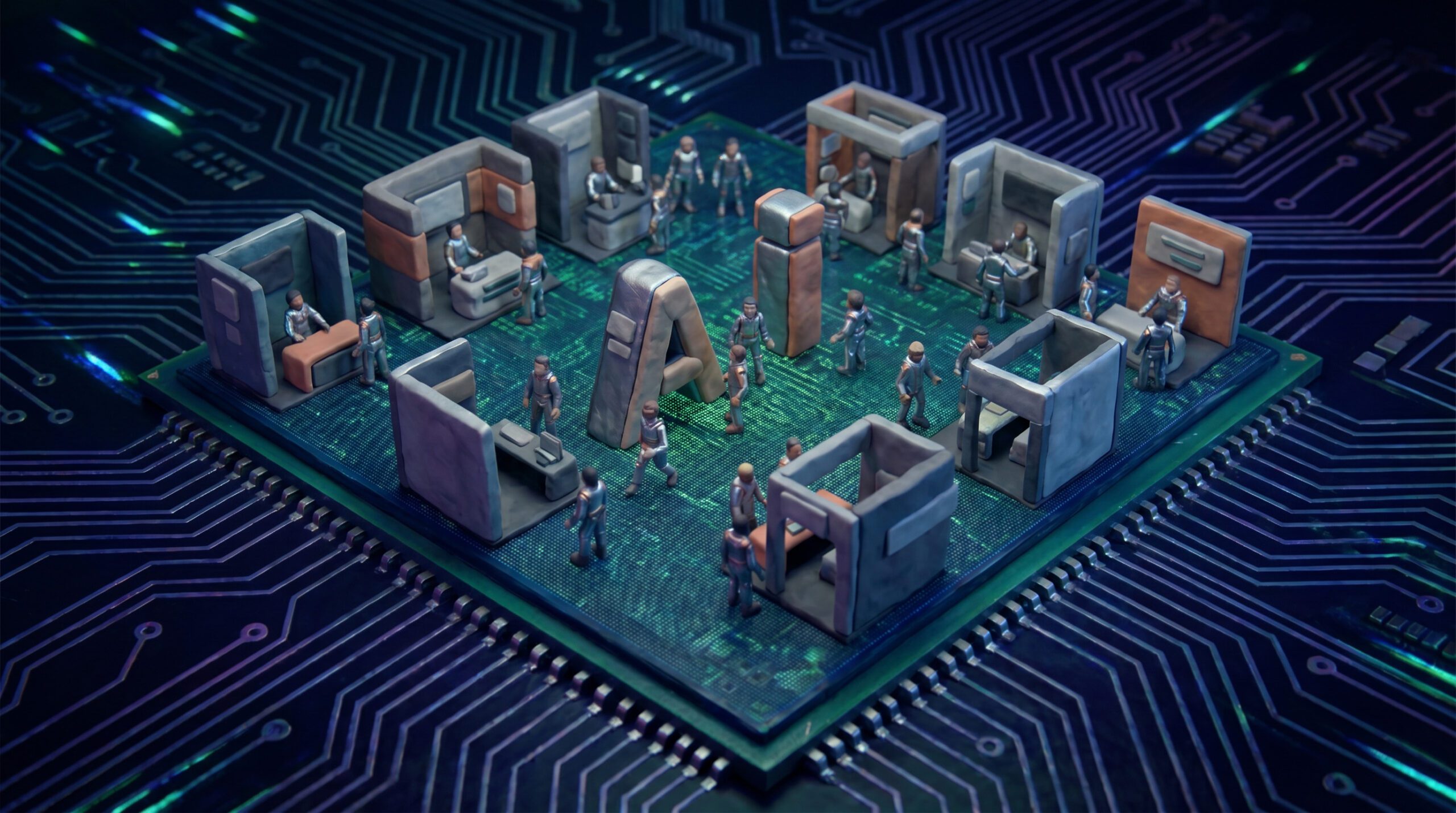
Not every video fits every trade fair. Based on our experience and industry literature, six formats stand out as particularly effective.
First, the “problem-solver” clip. Using simple animation or live-action footage, you show which problem your service or product addresses. (Source: Prankl Consulting) AI-generated scenes work particularly well here because they can also visualise abstract use cases.
Second, concise customer voices. A 60-second interview with a satisfied customer on site answering key questions feels authentic and persuasive. (Source: Prankl Consulting) With AI, you can then distribute those statements in multiple languages without reshooting.
Third, live insights from the event. Stream short clips from your booth and the surrounding action. (Source: Prankl Consulting) AI-based editing solutions deliver highlight reels for social media on the same day.
Fourth, explainer videos. Trade fairs and conferences are dynamic events where visitors are often in a hurry. An explainer video captures attention in seconds and communicates complex messages clearly. By combining visual and auditory elements, information stays in memory better than pure text or images. (Source: Erklaerungsvideo.ch)
Fifth, product demonstrations in AI-generated environments. Especially for products that cannot be presented at full scale on the booth, industrial systems, vehicles, complex machinery, AI videos enable virtual tours that complement the physical booth experience.
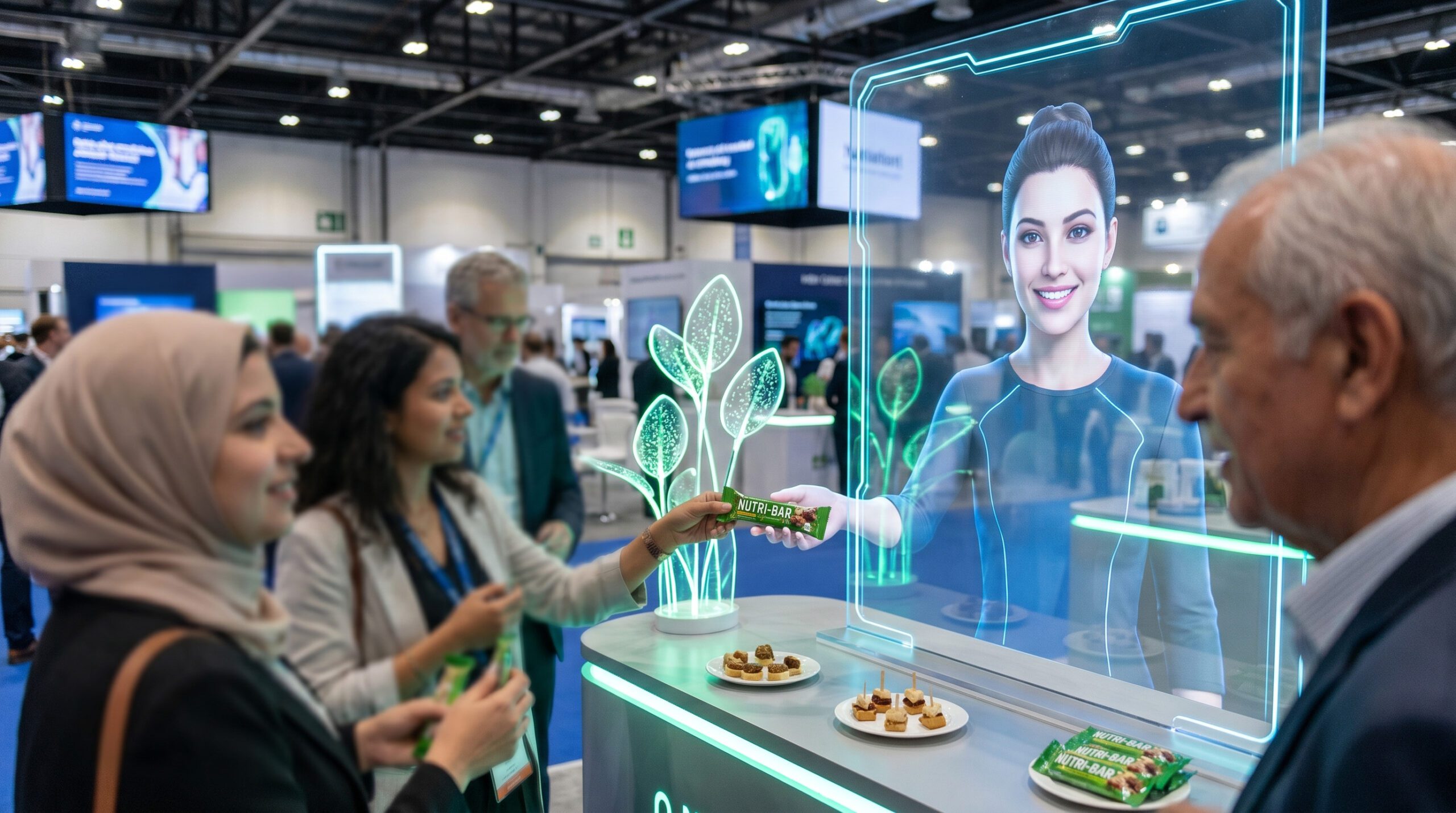
Sixth, interactive AI avatars as booth hosts. Digital representatives become the face of your brand and interact with visitors 24/7. They recognise visitor preferences from previous interactions and adapt expressions and tone. (Source: KI-Trainingszentrum) One car manufacturer used avatars as test drive experts and boosted lead generation by 140 percent while cutting costs by 35 percent. (Source: KI-Trainingszentrum)
The Flagship Case: Messe Düsseldorf as a Pioneer
A real-world example shows how far AI videos have come: Messe Düsseldorf became the first German trade fair organisation to produce a fully AI-generated advertising campaign. As part of the exhibitor campaign for XPONENTIAL Europe 2026, Europe’s leading trade fair for autonomous technologies and robotics, three innovative films were created, including the visionary brand film “What if” along with two thematic videos on space and defence. (Source: XPONENTIAL Europe)
The films are more than a creative experiment: as part of the international exhibitor campaign, they generate attention, reach, and emotion, and give a preview of the diversity of autonomous technologies before the fair even opens. (Source: XPONENTIAL Europe) The example shows that AI video is not just about cost optimisation but also a creative tool for powerful storytelling.
Best Practices: What Actually Works at the Booth
Practice and industry literature offer clear rules for effective trade show videos. The most important: keep it short. Trade show videos should not exceed 60 to 120 seconds because visitor attention spans are brief. (Source: Scribble Video) A good booth film tells a story with a clear structure: problem, solution, call to action. Visitors must grasp the point immediately. (Source: Scribble Video)
Consistency with your brand also matters. Colours, logo, and tone should be unified. A blurry or poorly edited video makes a bad impression, clean animations and high-quality production are non-negotiable. (Source: Scribble Video)
Regarding timing, another clear rule of thumb applies: the core message should be clearly articulated within the first 30 seconds, as trade show visitors often only watch in passing. (Source: Erklaerungsvideo.ch)
Beyond the Booth: Trade Show Videos Along the Entire Customer Journey
A strategic mistake we often see: trade show videos are produced exclusively for the booth. Yet they unfold their greatest impact when they accompany the full journey. Before the fair, you can raise awareness on social media, advertise your appearance, and highlight specific booth activities via email. (Source: Marketinginstitut)
During the fair itself, looping clips on the booth, animated displays at the entrance, or short social media teasers help drive foot traffic. Afterwards, it is time for follow-up videos: personalised clips referring to a specific conversation significantly increase the probability of closing. Digital tracking mechanisms and structured measurement make these metrics transparent today. (Source: The Digitale)
This approach turns an event into a scalable pipeline for meaningful conversations with potential customers. (Source: The Digitale)
The ROI Effect: Why the Investment Pays Off
The ROI of AI video at trade shows arises on several levels simultaneously. First, through cost reduction: 50 to 70 percent less production effort compared to traditional methods. (Source: IXSOL) Second, through speed: content on the same day instead of 10 to 14 days later, which directly translates to higher conversion in lead follow-up. (Source: Middayfilm)
Third, through scalability. Once produced, an AI video can be transferred into multiple languages, adapted for different channels, and reused at subsequent trade fairs. This significantly lowers the cost per impression.
Fourth, and often underestimated: through interaction quality. Modern systems analyse in real time what visitors are actually interested in. They adjust content dynamically, from individualised product suggestions to interactive booth design. One mechanical engineering company used such animations to make complex manufacturing processes understandable and doubled interaction time, while boosting lead quality by 40 percent. (Source: KI-Trainingszentrum)
Limits and Pitfalls: Where AI Video Hits Its Boundaries
Despite all the enthusiasm: AI is not a silver bullet. Image and video generation make content production easier than ever, but not attention. More AI content does not automatically mean more impact. (Source: KI Day)
Moreover, you still need a professional framework. ROI is achieved by using AI within a proven production framework, not by relying on AI as an end in itself. (Source: Middayfilm) In other words: strategy, storytelling, and brand stewardship must be in place before AI generation makes any sense.
You should also critically assess moving-image quality. Not every AI model delivers brand-worthy results. For industries with high visual standards, luxury, premium B2B, medical technology, we recommend hybrid formats that deliberately combine live-action and AI-generated sequences.
Conclusion: AI Video Belongs in Every Trade Show Plan Today
Trade shows remain one of the strongest B2B marketing measures. AI videos make this measure faster, cheaper, and more effective, provided they are deployed strategically. Anyone who views AI only as a cost-cutter is wasting potential. Those who use it as a lever for personalisation, speed, and scaling gain a real competitive advantage.
At ThatWorksMedia, we concept and produce videos that make this difference. Less noise. More signal.
FAQ: Frequently Asked Questions About AI Videos for Trade Shows
How long should an AI video for a trade show booth be? Ideally between 60 and 120 seconds. The core message should be clearly articulated within the first 30 seconds because trade show visitors often watch only in passing. (Source: Scribble Video, Erklaerungsvideo.ch)
When is the ideal time to start planning trade show videos? For optimal results, strategic planning should begin at least 4 to 6 months before the trade fair. (Source: Effecticore) Thanks to AI, short-notice productions are possible, but strategy and audience definition take time.
How much do I save with AI video compared to traditional production? On average, 50 to 70 percent of production costs, because AI tools automate manual tasks such as editing, post-production, and effects. (Source: IXSOL)
Can I distribute AI video in multiple languages? Yes. Modern platforms support up to 160 languages with accurate lip-sync, ideal for international trade fairs and multilingual audiences. (Source: Synthesia)
Which formats work particularly well at trade shows? Problem-solver clips, concise customer voices, live insights from the booth, explainer videos, virtual product demonstrations, and interactive AI avatars as booth hosts. (Source: Prankl Consulting, KI-Trainingszentrum)
How quickly can I produce AI videos during a running trade show? With AI-supported production frameworks, content assets can be delivered on the same day, compared to 10 to 14 days with traditional production. (Source: Middayfilm)
Will AI replace classic video production? No. AI does not replace professional crews; it eliminates the time gap between the moment and the message. The greatest potential lies in hybrid productions that combine live-action and AI-generated elements. (Source: Middayfilm)
Which trade fairs are already using AI video? Messe Düsseldorf became the first German trade fair organisation to produce a fully AI-generated advertising campaign, for XPONENTIAL Europe 2026. More organisations are following suit. (Source: XPONENTIAL Europe)
Do I have to label AI videos? Starting August 2026, the EU AI Act requires that AI-generated content resembling real people must be clearly labelled. (Source: kopfundstift.de)
ThatWorksMedia is a Berlin-based AI video production and content agency. We concept and produce trade show films, explainer videos, AI-generated video, and social media content for B2B clients. Less noise. More signal.