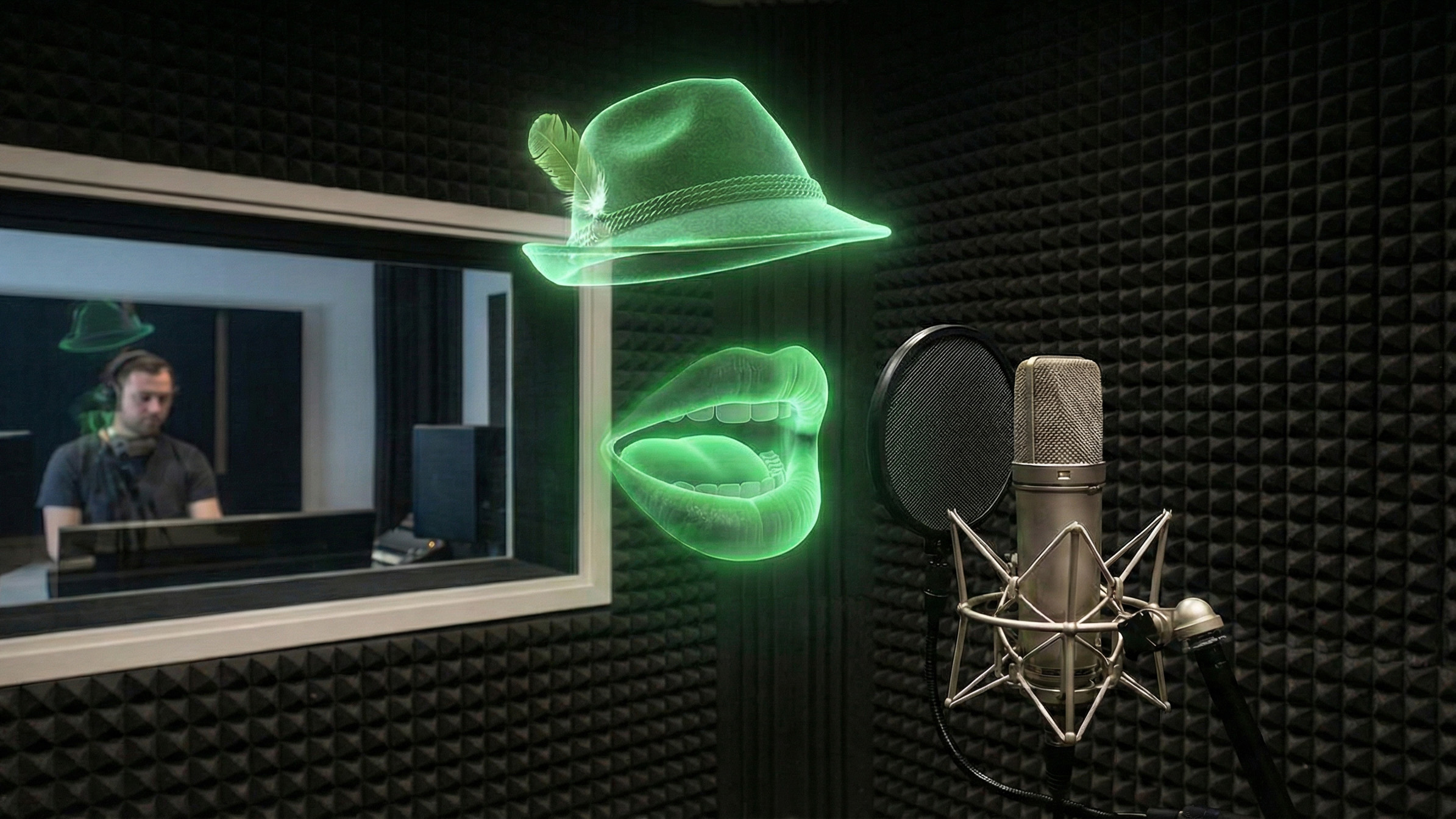
The Growing Demand for AI Voice
Explainer videos, e-learning, podcasts, social media: professional voice recordings are now a staple of content production. At the same time, content must be produced faster and updated more frequently. The global text-to-speech market is growing at over 15 percent annually and is projected to reach approximately $9.3 billion by 2033. (Source: Business Research Insights, TTS Market Report, September 2025)
Modern AI voices now sound so natural that in many cases they are barely distinguishable from real speakers. German voices were long a weak point – monotone, robotic, struggling with umlauts and compound words. That changed fundamentally in 2025/2026. In this article, we compare the best tools offering high-quality German voices and explain what to look for when choosing one.
What Exactly Is an AI Voiceover Tool?
An AI voiceover tool converts written text into spoken language using artificial intelligence. Unlike older TTS systems, modern tools use neural networks and deep learning to automatically adjust emphasis, tempo, emotions, and pauses. The result is voices that sound natural and lifelike.
Many platforms now also offer voice cloning – the ability to clone your own voice and have the AI replicate it. This is particularly interesting for businesses that want to maintain a consistent brand voice across large volumes of content.

The 6 Best Tools at a Glance
1. ElevenLabs – The Quality Leader
ElevenLabs has established itself as the leading provider and was valued at $11 billion in 2026. The tool offers over 100 German voices that were rated as “very human” by nearly 90 percent of respondents in independent tests – a top score in the industry. (Source: ElevenLabs Blog, Series D, January 2026; Kopf & Stift, 2026)
The voice cloning is particularly impressive: just 60 seconds of audio material is enough to clone a voice with remarkable accuracy. Thanks to the multilingual model, a cloned voice can even speak languages the original owner doesn’t know – while retaining its characteristic sound.
- Free plan: 10,000 characters per month (approximately 10 minutes)
- From $5/month: voice cloning and commercial usage rights included
(Source: All-AI.de, 2026; OMR Reviews, 2026)
2. Fliki – Largest German Voice Selection
Fliki stands out with by far the largest selection: over 180 German voices, including standard and so-called “Ultra Realistic Voices” with especially natural intonation. Additionally, Fliki is not purely an audio tool – it combines voice generation with an integrated video editor. Ideal for teams that want to produce content in a single workflow. (Source: Helped by a Nerd, October 2025; Gradually.ai, 2026)
- Voice cloning in German: available from the Standard plan ($28/month)
- Premium voices: from $88/month with 10 hours of audio and video quota
3. Murf AI – E-Learning Specialist
Murf AI is specifically aimed at businesses and e-learning providers. With its Speech Gen 2 technology, Murf achieves a pronunciation accuracy of 99.38 percent – crucial for professional corporate communication.
What sets Murf apart is its timeline editor: audio can be synchronized to video with frame-level precision, and pitch, pauses, and speed can be adjusted down to the millisecond. Team features and an API for integration into existing systems round out the package.
- German voices: currently 7 – significantly fewer than ElevenLabs or Fliki
- From $26/month
(Source: Kopf & Stift, 2026; Murf.ai; SEO-Tech.de, 2024)
4. LOVO (Genny) – Emotional Storytelling
Over 500 voices in more than 100 languages and 25 emotional expressions – from joy and whispering to sadness. When voiceovers need to convey feeling, LOVO is a compelling option. However, the German voices sound less natural compared to the English variants, as no German premium voices are offered.
- From $24/month
(Source: Kopf & Stift, 2026; Gradually.ai, 2026)
5. Narakeet – Unique for Swiss German
The only tool on the market with dedicated Swiss German voices. For content creators in Switzerland who need authentic regional pronunciation, this is a genuine differentiator. Narakeet also operates without a subscription model – you only pay for what you use. Ideal for occasional applications or smaller projects. (Source: Kopf & Stift, 2026)
6. Speechify – Accessibility and Read-Aloud
Speechify is less a production tool and more a read-aloud app: over 200 voices in more than 60 languages, with free voice cloning. Well suited for making blog posts, internal documents, or web content available as audio. For professional video production, however, the voice quality doesn’t quite match ElevenLabs or Fliki. (Source: TopMediai, 2026; Speaktor, 2025)
Comparison Table
| Tool | German Voices | Voice Cloning | Free Tier | Starting Price | Best For |
|---|---|---|---|---|---|
| ElevenLabs | 100+ | Yes (from $5) | 10 min/month | $5/month | Best quality, advertising |
| Fliki | 180+ | Yes (from $28) | 5 min/month | $28/month | Video + audio, teams |
| Murf AI | 7 | On request | 10 min (one-time) | $26/month | E-learning, enterprise |
| LOVO | 19 | Yes (Pro) | 14-day trial | $24/month | Emotional storytelling |
| Narakeet | Various | No | Pay-per-use | Variable | Swiss German |
| Speechify | Several | Yes (free) | Yes | $99/month | Accessibility |
(Compiled by ThatWorksMedia, Berlin – based on manufacturer specifications and independent tests, as of February 2026)
What to Look for When Choosing
Quality of German voices The most important factor. Many tools sound excellent in English but fall short in German – particularly with compound words, umlauts, or longer technical texts. It’s worth testing each tool with a real text from your own use case. (Source: TopMediai, 2026)
Premium vs. standard voices Almost all providers distinguish between standard and premium voices. The difference is noticeable: premium voices sound markedly more natural, offer better intonation, and deliver higher recording quality. For professional applications, a plan with premium voices is always worthwhile. (Source: Gradually.ai, 2026)
Voice cloning and brand voice For businesses wanting to maintain a consistent brand voice, voice cloning capabilities are essential. ElevenLabs offers the best value with instant cloning from $5. Important: you may only clone your own voice or voices with explicit consent.
Commercial usage rights Not every AI voice may be used commercially. Free tiers in particular often lack commercial licenses:
- ElevenLabs – commercial rights included from $5/month
- Fliki – commercial rights included from $28/month
(Source: Kopf & Stift, 2026; Gradually.ai, 2026)
Typical Use Cases
E-learning and training videos AI voices make it possible to narrate course content consistently – even across 20 or more lessons. Script changes don’t require a new studio session, just a text adjustment. For businesses that regularly update compliance training or product courses, this saves enormous time and budget.
Explainer videos and advertising Short, punchy spots can be produced with AI voiceover in minutes rather than hours. Multiple variants with different emphasis or speaking speed are quickly created – ideal for A/B testing.
Multilingual localization With voice cloning, an English brand voice can suddenly speak German, French, or Spanish – while retaining its unique character. This makes international campaigns significantly more efficient.
Accessibility AI voiceover enables text content to be provided as audio – for people with visual impairments and anyone who prefers listening over reading.
Dialects: Can AI Do Bavarian or Berlin German?
The German-speaking world is enormously diverse linguistically. Standard German, Bavarian, Saxon, Swabian, Cologne dialect, Berlin German, Austrian German, and Swiss German – the differences are sometimes so large they almost feel like separate languages. For businesses wanting to reach their audience regionally, the question is: can AI tools handle dialects?
The honest answer: it’s getting better, but there are still clear limitations. Most tools focus on standard German, where training data is most abundant. Nevertheless, there are promising developments:
- ElevenLabs – the only major provider explicitly offering a Bavarian accent; through voice cloning, any dialect can be replicated provided sufficient training material is available; ElevenLabs states it recognizes regional variants including Standard German, Bavarian, Austrian, Swiss German, Berlin, Cologne, and Saxon dialects (Source: ElevenLabs, German TTS Docs)
- Narakeet – occupies a unique niche as the only tool with dedicated Swiss German voices, a genuine advantage since standard German is often perceived as distant by Swiss audiences (Source: Kopf & Stift, 2026)
- Resemble AI – pursues an interesting approach with cross-language voice transfer: a voice can be cloned in one language and deployed in another, including regional variants; for GDPR-sensitive businesses, Resemble AI also offers an on-premise solution (Source: Kopf & Stift, 2026)
Our recommendation: produce standard content in clear High German – it reaches the broadest audience and sounds convincing on all current tools. For targeted regional campaigns, voice cloning of an authentic dialect speaker or the use of a human voice artist is worthwhile. Development is progressing rapidly: with growing training data, dialect voices should become significantly more available within the next one to two years.

AI Voiceover vs. Professional Voice Artists
Do AI voices fully replace professional speakers? Not in every context yet. For commercials with very high emotional demands, film dubbing, or fiction audiobooks, a human voice artist remains the better choice. The nuances an experienced actor brings to a dialogue are not yet fully within AI’s reach.
However, the boundaries are shifting rapidly. For e-learning, explainer videos, training content, product videos, and social media content, AI voices already deliver professional results – in a fraction of the time and at a fraction of the cost:
- Professional voice artist: typically €150 to €500 per project
- AI-generated voiceover: just a few euros per piece
- Key advantage: script changes don’t require a new studio session
(Source: AI Tool Discovery, December 2025)
5 Practical Tips for Better AI Voiceovers in German
- Optimize the text beforehand – AI voices read exactly what they’re given; short sentences, natural pauses through punctuation, and spelled-out abbreviations make a noticeable difference
- Match the voice to the content – an explainer video about financial products requires a different tone than an onboarding video; testing multiple voices pays off
- Use premium voices – the quality differences are often substantial; for anything external-facing, always opt for premium
- Don’t skip post-production – background music, noise reduction, and volume balancing make the difference between good and professional
- Check the legal framework – verify commercial usage rights, ensure consent for voice cloning, and be aware of EU AI Act labeling obligations
Frequently Asked Questions (FAQ)
Do AI voices sound natural in German? Yes – with ElevenLabs and Fliki, premium voices are rated as “very human” by around 90 percent of listeners. Standard voices from lower-cost providers often still sound noticeably artificial.
Can I clone my own voice? Yes – with ElevenLabs from just 60 seconds of audio material, and with Fliki from the Standard plan at $28/month.
Are there free options? ElevenLabs (10 min/month), Fliki (5 min/month), and LOVO (20 min/month) offer free tiers – though typically without commercial rights or premium voices.
Which tool for e-learning? Murf AI for enterprise applications with precise pronunciation, Fliki for a large voice selection plus video editor, ElevenLabs for the highest audio quality.
Is Swiss German available? Only Narakeet offers dedicated Swiss German voices. Alternatively: voice cloning via ElevenLabs with appropriate training material.
Do I need to label AI voiceovers? Under the EU AI Act, AI-generated content must be labeled in certain contexts – particularly when it could be confused with a real person.
How long does production take? The generation itself takes seconds to minutes. Including text optimization, voice selection, and post-processing, plan for 30 to 60 minutes – compared to hours or days for a traditional studio recording.
Conclusion
The quality of German AI voices made an enormous leap in 2025/2026. ElevenLabs delivers the highest audio quality and best voice cloning, Fliki offers the largest German voice selection with a video workflow, Murf AI provides the strongest enterprise solution, and Narakeet remains the only Swiss German option. For emotional advertising and film, the human voice artist remains superior – but for e-learning, explainer videos, and content production, AI voices are already the more efficient choice.
Want to use AI voiceover for your next project? We’re happy to advise – from voice selection to finished production. Contact: thatworksmedia@gmail.com